
Private Reserves
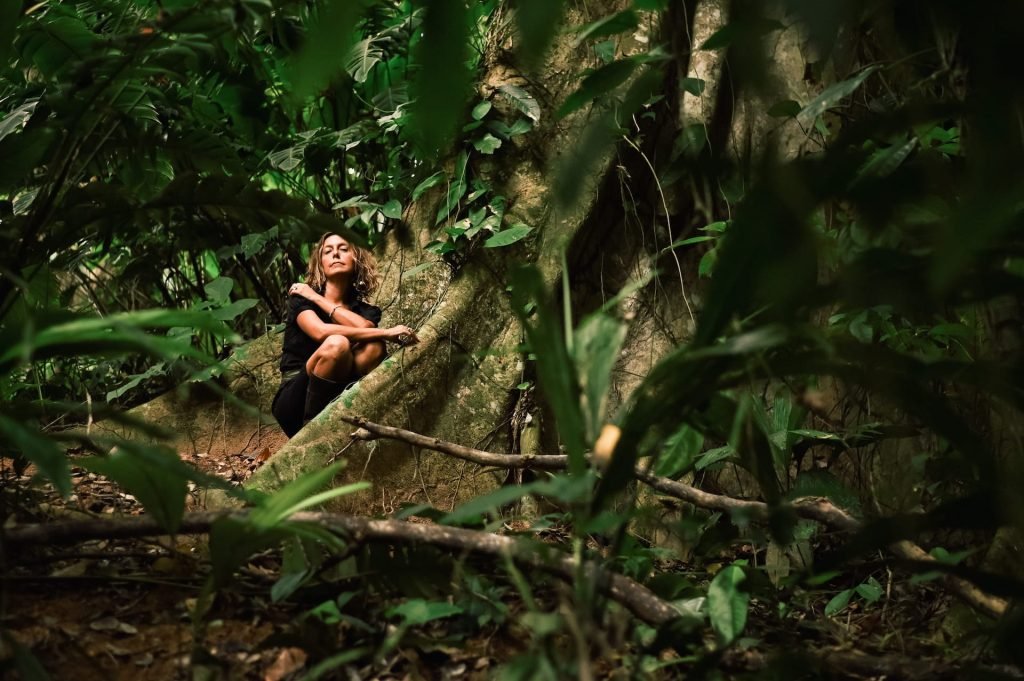
The privilege of inhabiting a living ecosystem
One of my greatest achievements is having carved out a life that has allowed me to do without an alarm clock for decades. For the past seven years, I have woken up every morning to the howl of monkeys living in the treetops surrounding my home, in one of the most biodiverse ecosystems on the planet. Many of them arrived here after the neighbouring plots were cleared to make way for new buildings.
I bought this estate in 2020 with the intention of creating a development comprising seven sustainable homes. Five years on, I am still living in the only house I have built on the site, in an area that had previously been deforested. I now intend to scale back the development to a micro-community of three homes. By taking the time to experience the place, I realised that the true value lay in the forest. Although it is not officially primary forest, what was once an abandoned cocoa plantation has, over the course of fifty years, become a fantastic ecosystem teeming with life that deserves to be conserved and cared for.
It is not the first time something like this has happened to me. On paper, anything is possible; in reality, nature often harbours hidden treasures that no map can show. And yet what has happened with this land does not contradict my method , it validates it. It is the organic, and also economic (though I have struggled to see it), evolution of having done this work with care for long enough. It is not about arriving with a preconceived idea and putting the plan into action. It is about a wiser, slower approach: arriving with respect, with questions, observing carefully, and only then putting a plan together. It turns out that slow living requires a certain level of slow planning.
I have spent twenty-five years buying degraded land, regenerating it, building on it and selling properties. I have developed retreat centres, consolidated plots, designed agroforestry systems and, along the way, made enough mistakes to have learnt some important lessons. Until I came to this plot, I had never encountered a situation where nature had beaten me to the punch on regeneration, and where the real need was simply to conserve.
My methodology is simple: we don’t put up walls before understanding the land and its elements. Water, sun, wind, slope, plants , these are some of the elements of a system that needs to be fully understood. From there, you decide where, and to what extent, it makes sense to intervene. I am referring to the approach humans have practised since the dawn of time, until consumer real estate became a machine that devours landscapes and mass-produces disposable, flavourless architecture.
One thing seems increasingly evident: a mature ecosystem has a value that the conventional property market has yet to wake up to , the value of what is scarce, of what cannot be reproduced, of what is unfortunately almost extinct. Not because nature cannot regenerate, but because ecological time does not operate at the speed of financial capital. For the forest to remain a forest, there must be someone who deliberately chooses not to turn it into something else. And in a world where the majority does the latter, those who do the former possess something that almost no one else has. The true privilege today is not to build a house in a living ecosystem, but to inhabit it and, in turn, decide that it should remain so.
A native forest, these days, behaves increasingly like a collector’s item: the global stock is dwindling every year, at an accelerating rate, and production , let’s put it this way , does not exist. A mature forest is not planted; it emerges, and at best, is preserved. A regenerated estate with a native forest and a small edible garden, smart water systems and thirty years of deep roots, is not something that can be created overnight.
My decision to go from seven houses to three did not stem from some aura of ecological sanctity, but from the realisation that preserving part of the land intact, while developing a space for human life, could generate more value , economic, experiential and emotional , than exploiting every last square metre.
My position is not that of radical conservation. That human beings occupy space is something I have come to accept, after going through a phase of ecological absolutism in my youth which, I believe, was what was needed at the time. My proposal is one of intelligent intervention, with a design conceived as a holistic legacy. Not as a sacrifice, but as a deeply pleasurable way of living: my own version of Bjarke Ingels’ Sustainable Hedonism, with an extra dash of philosophy.
Waking to the sound of the forest, bathing in a pristine stream, eating home-grown fruit and feeling your body slow down is by no means a sacrifice. It is a rare pleasure. The true privilege today is not more square metres of built space, but the ability to participate in the continuity of something living.
And I am increasingly convinced that preserving habitable ecosystems may well turn out to be one of the wisest decisions of our generation , economically, ethically, and for our very survival. A commitment to life, amidst the widespread loss of natural spaces now surrounding us.
