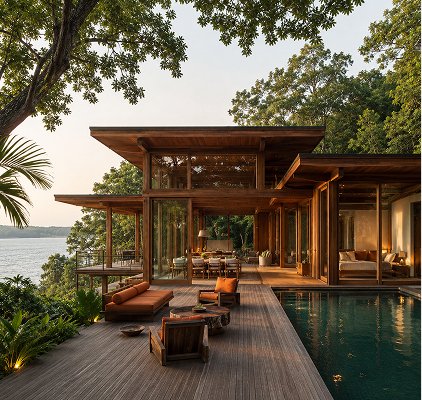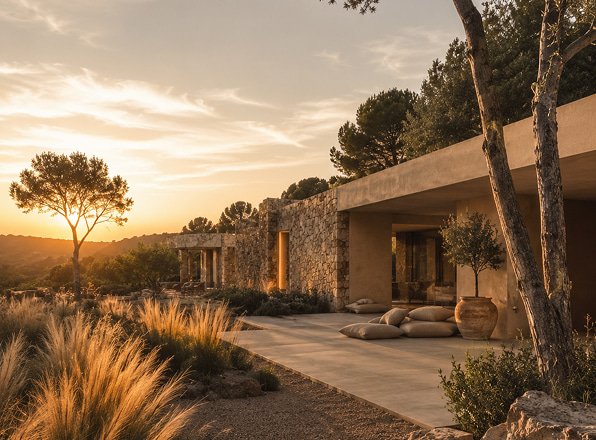

Structured Developments

for Developers and Investment Groups

Structured Developments

Large landscapes rarely remain coherent when fragmented into speculative plots. Standard development logic optimises for unit count, construction cost, and short-term exit. The result is land that loses coherence, character, and long-term value in the process.

But when land is structured intentionally — with governance, precise management systems, and ecological and financial intelligence — it can become something of a different order: a living system that holds value, preserves landscape, and supports long-term habitation.

What I Bring to a Project

Most development projects fragment the thinking. Architects design buildings. Landscape designers design gardens. Financial advisors model returns. Nobody holds the whole.

My contribution is concept coherence: a single integrated framework that aligns land, ecology, architecture, operational systems, and capital logic into one argument. A developer who works with me does not receive a design service. They receive a project thesis — and the strategic consulting to execute it without losing the thread.

This may include:

— reading the ecological and strategic value of the landscape before any capital is committed.

The Market Position

A well-conceived regenerative development occupies a space that standard development cannot reach. The ecological integrity is real and verifiable. The architecture is distinctive. The operational systems create ongoing value for buyers — not just at point of sale. The land improves with time. This is not a niche. It is an underserved position in a market where differentiation is increasingly difficult and buyers with significant capital are looking for exactly what this model offers: land that is alive, managed, and built to last.

The Market Position

Who This Is For

This work is typically relevant for:

  • Family offices exploring land as a long-term ecological asset
  • Developers seeking a differentiated, integrity-driven model
  • Aligned investor groups considering collective land acquisition
  • Capital holders interested in preservation through inhabitable estates

These projects reward long-term strategic thinking. They are financially sound while deliberately avoiding speculative development models.

Who This Is For

The Framework

From the outset, land is structured through an integrated framework that considers:

  • Architecture and spatial planning
  • Agroforestry systems
  • Permaculture-based food production
  • Forest preservation or regeneration
  • Landscape management systems
  • Operational governance

The objective is land that is ecologically intelligent, architecturally coherent, and financially sound. When structured well, land becomes more than a property — it becomes a productive asset capable of preserving capital, generating long-term value, and evolving into a meaningful legacy.

Why Multi unit Development Works

Large tracts of land are increasingly inaccessible to individual buyers. When structured intelligently, collective ownership allows:

  • Access to larger and more ecosystem meaningful landscapes
  • Shared infrastructure with a lighter environmental footprint
  • Professional management continuity
  • Greater preservation impact at scale
The Role I Play
Land Thesis

Land Thesis

Understanding the ecological and strategic value of the landscape — water systems, forest ecosystems, climate resilience, cultural context, and long-term ecological potential.

Capital Architecture

Capital Architecture

Designing a structure that aligns capital with long-term stewardship — covering land acquisition, infrastructure sequencing, value protection, and long-term viability.

Spatial Concept

Spatial Concept

Human-scale planning that balances privacy, landscape integrity, and shared space. Settlement patterns, landscape buffers, commons design, and architectural coherence.

Team Assembly & Strategic Direction

Team Assembly & Strategic Direction

A multidisciplinary team assembled as required — architects, regenerative landscape designers, forestry engineers, legal advisors, and infrastructure specialists. My role is to maintain strategic coherence as the project evolves.

Ownership & Governance

Projects are structured with a clear ownership framework and a pragmatic governance model. Rather than imposing rigid structures, the focus is on establishing simple, functional systems — comparable to a well-designed condominium — that allow land, infrastructure, and shared spaces to be managed effectively over time.

Long-term functionality, not bureaucratic complexity.